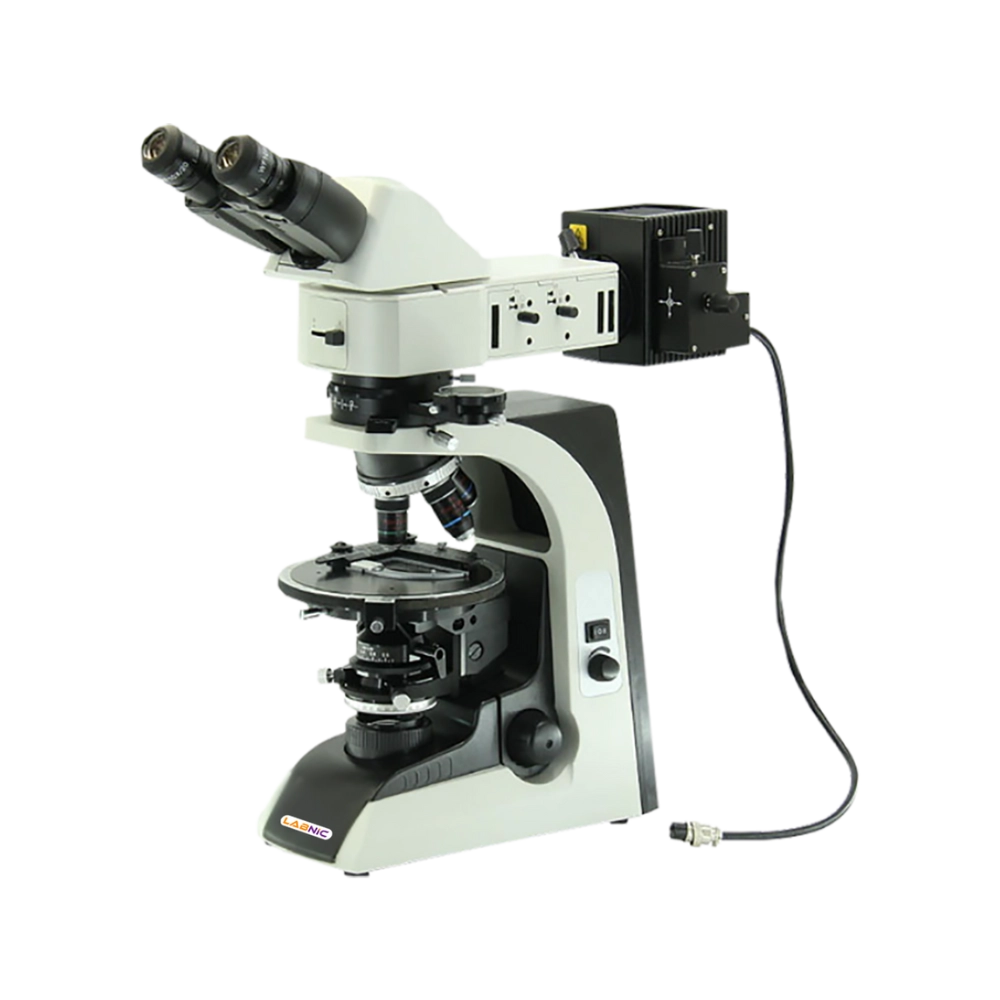
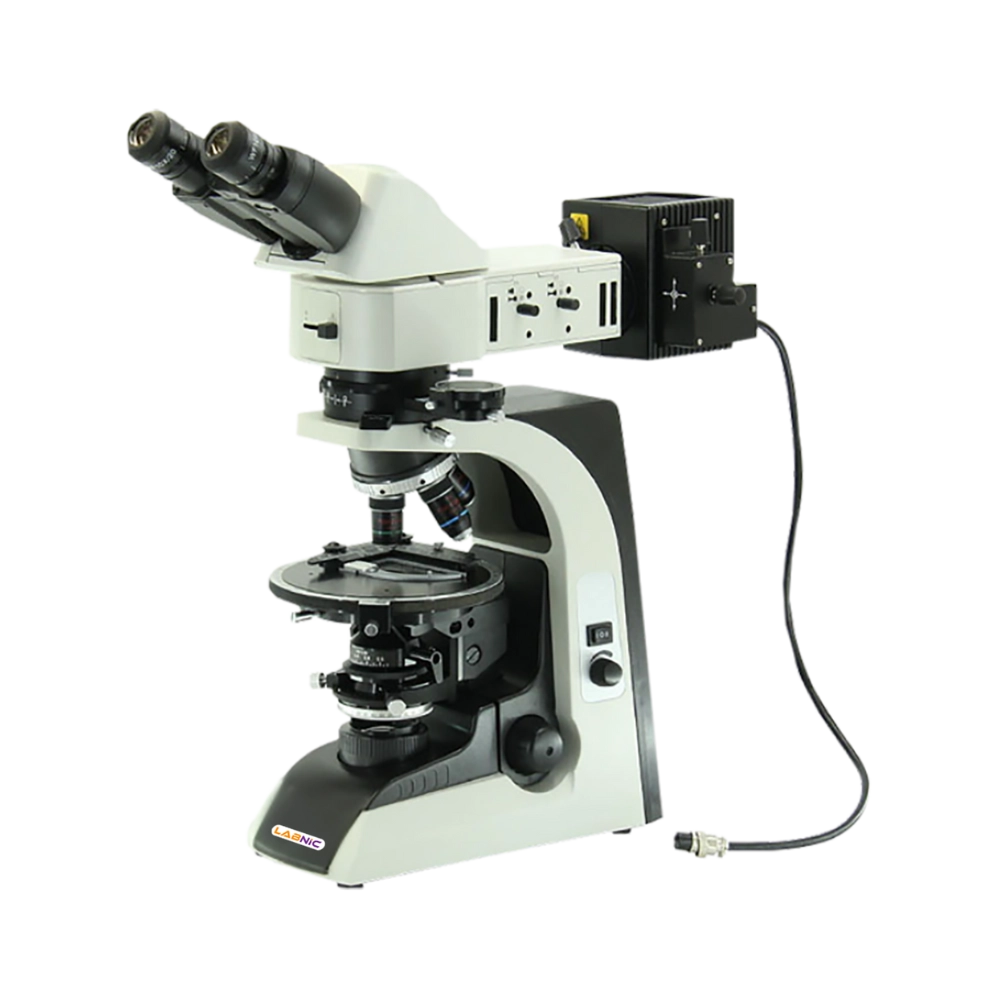
Polarizing Microscope LBN-PM121 consists of an achromatic optical system with a monocular head type, 30° inclination, and 360° rotation. It has a 23.2 mm micrometer eyepiece and a quadruple outward-revolving nosepiece with a strain-free objective. The microscope is equipped with an Abbe 1.25-aperture condenser with a rack and pinion up/down feature and a halogen light source.
| Optical System | Achromatic |
| Standard Magnification | 40x – 400x |
| Head Type | Monocular |
| Inclination | 30° |
| Rotation | 360° |
| Eyepiece | WF10x/18mm, with cross micrometer 2 pc |
| Eyepiece Diameter | 23.2 mm |
| Nosepiece | Outward, 4 holes |
| Objective | Non-stress achromatic 4x/0.10, W. D= 18.6 mm, 10x/0.25, W. D= 6.5 mm, 40x/0.6, W. D= 0.47 mm |
| Working Stage Type | Round Stage, lockable |
| Stage Size | Diameter 142 mm, Division 1 inch, Vernier Division 6 inch |
| Focusing Type | Coaxial Coarse and Fine |
| Condenser | Abbe, 1.25 N. A |
| Light Source Type | Halogen |
| Transmit Light | 12V20W Halogen, with Blue Filter on Light Collector |
| Power Supply Type | AC 100V-240V Wide Voltage |
| Polarizing | Analyzer Media unit 0-90° adjustable, with removable betrend lens built-in, compensator slide, 3 holes, with ƛ slip (First Class Red) + 1/4 ƛ slip |
| Dimensions (L × D × H) | 340 × 250 × 420 mm |
| Net Weight | 5 Kg |
| Gross Weight | 6.5 Kg |
Polarizing Microscope is used to study the polarized light effect on a specimen in the fields of science, forensic analysis, geology, medicine, chemistry, biology, and metallurgy.
Polarizing Microscope is used to study the polarized light effect on a specimen in the fields of science, forensic analysis, geology, medicine, chemistry, biology, and metallurgy.
Most Frequently Asked Questions
1. What are Polarizing Microscopes used for?
Ans. Polarizing Microscopes are used to study specimens that exhibit different light behaviors, enabling detailed structural analysis.
2. How do Polarizing Microscopes ensure clear specimen viewing?
Ans. Polarizing Microscopes feature high-quality optical systems that deliver sharp, clear images with enhanced detail.
3. What lighting features are available in Polarizing Microscopes?
Ans. Polarizing Microscopes include adjustable light settings to optimize visibility for different sample types.
4. How do Polarizing Microscopes improve image contrast?
Ans. Polarizing Microscopes are equipped with polarizers and analyzers that enhance contrast and reveal optical properties.
5. What role does the rotating stage play in Polarizing Microscopes?
Ans. Polarizing Microscopes feature rotating stages that allow precise positioning and orientation of samples.
6. Where are Polarizing Microscopes commonly used?
Ans. Polarizing Microscopes are commonly used in forensic analysis, geology, medicine, biology, and research laboratories.
Polarizing Microscope LBN-PM121 consists of an achromatic optical system with a monocular head type, 30° inclination, and 360° rotation. It has a 23.2 mm micrometer eyepiece and a quadruple outward-revolving nosepiece with a strain-free objective. The microscope is equipped with an Abbe 1.25-aperture condenser with a rack and pinion up/down feature and a halogen light source.