
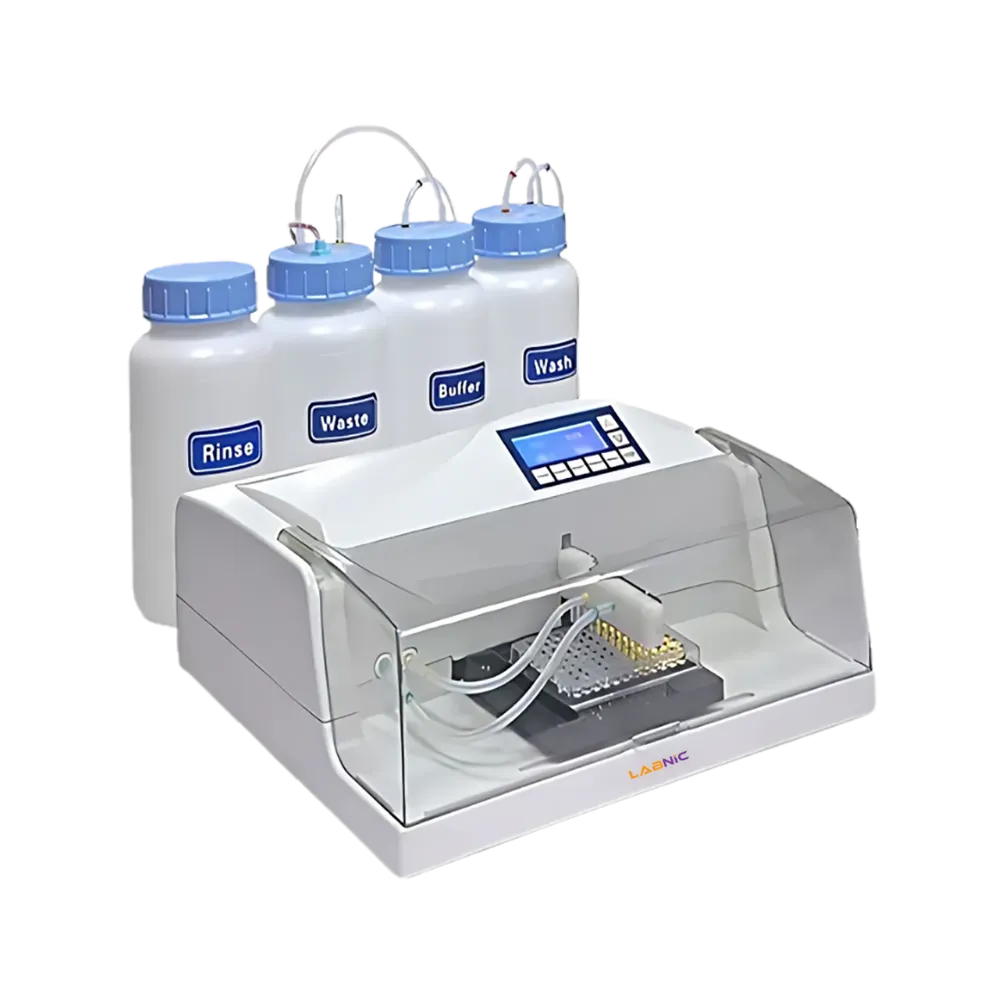
ELISA Microplate Washer LBN-EMW121 is equipped with large LCD screen display with menu interface. It has large memory storage which can store up to 48 user programmed wash protocols. It is used to control the procedure of washing experimental samples arranged in plate-based formats. It improves the speed and accuracy of different washing procedures.
| Display | Large display |
| Washing | Whole plate washing Single strip washing |
| Volume | Low residual volumes by two pipettes |
| Vacuum | Automatic monitoring of vacuum and pressure |
| Memory | Large memory to store up to 48 user programmed ash protocols |
It is widely applied in the field if medical centers, industrial sectors, educational institutes, hospitals and clinical sectors
It is widely applied in the field if medical centers, industrial sectors, educational institutes, hospitals and clinical sectors
Most Frequently Asked Questions
1. What is a Microplate Washer?
Ans. A microplate washer is a laboratory instrument used to wash microplate wells by removing unbound substances and contaminants.
2. What are the key applications of a Microplate Washer old?
Ans. It is used in ELISA for precise washing, in cell-based assays to remove excess reagents, in bead-based assays for thorough bead cleaning, in nucleic acid purification to eliminate contaminants, and in protein and antibody washing for improved assay accuracy.
3. What types of microplates can be used?
Ans. Our microplate washers are compatible with 96-well and 384-well plates.
4. What types of washing modes are available in a Microplate Washer?
Ans. Our microplate washers offer strip washing and full plate washing.
5. How do you prevent clogging in the washer’s nozzles?
Ans. Regular maintenance, flushing with distilled water after use, and using filtered buffers can help prevent clogging of the dispensing and aspiration nozzles.
