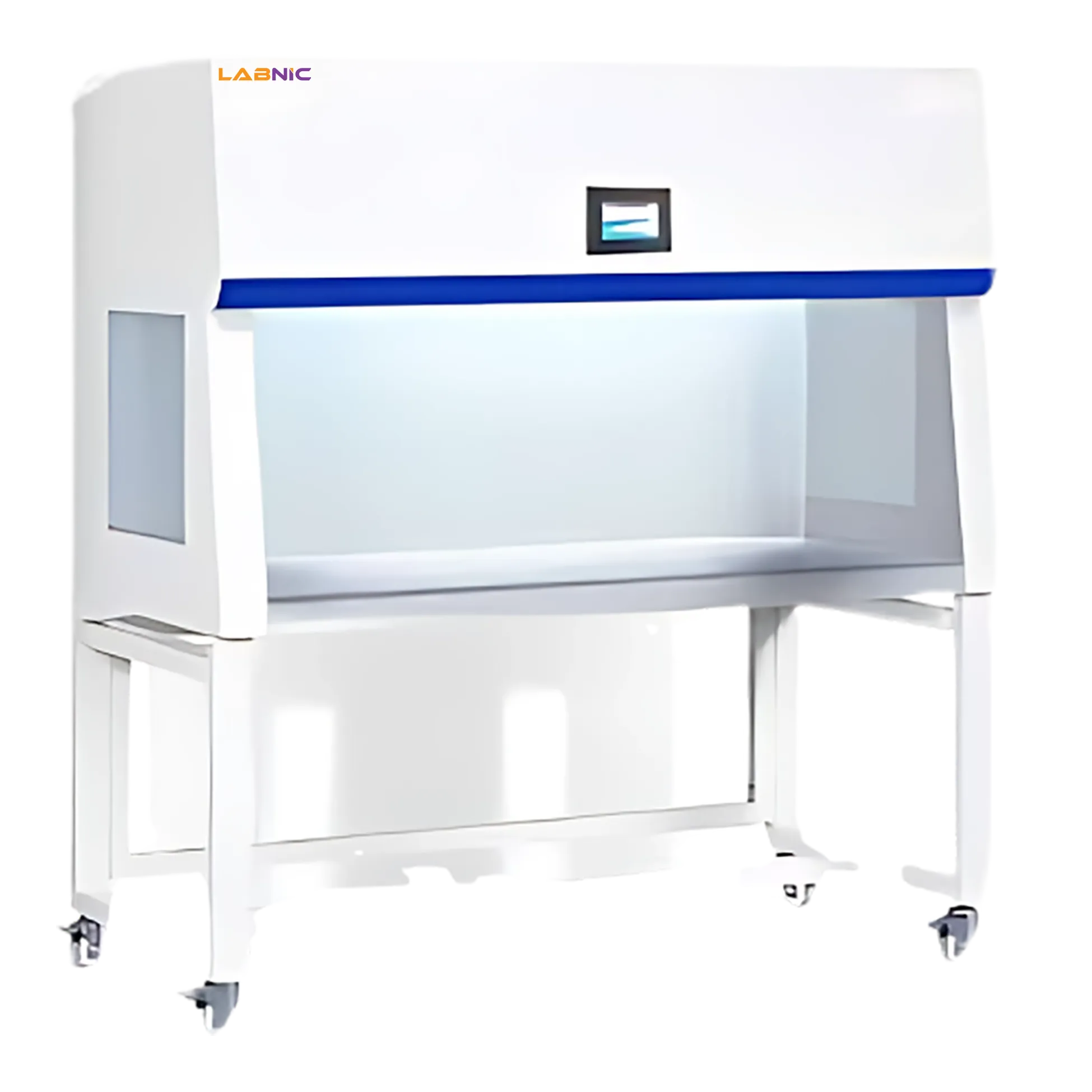


Vertical Clean Bench LBN-VC132 generates precise laminar airflow via a high-quality HEPA filter. It has a wind speed of 0.3 to 0.6 m/s, and air is forced through the HEPA filter before entering the chamber via a diffuser, which distributes particle-free, clean air over the entire work surface without contamination. When handling a critical component, the anti-corrosion resistance of the SUS304 stainless steel work surface combined with the ultra-smooth vertical laminar airflow creates an ideal environment.
| Wind Speed | 0.3 to 0.6 m/s |
| Vibration Half Peak | ≤3μm(X, Y, Z direction) |
| High-Efficiency Filter | Efficiency 99.99% |
| Illumination | ≥ 300 LX |
| Noise | ≤ 62dB |
| Ambient temperature | 10 to 30℃ |
| Relative Humidity | <70% |
| Power | 870 W |
| Voltage | AC220V/50Hz |
| Internal Dimension (H×W×D) | 500 × 1300 × 680 mm |
| External Dimension (H×W×D) | 1585×1460×735 mm |
| Package Dimension (H×W×D) | 1030 × 1650 × 855 mm |
| Net Weight | 210 Kg |
| Gross Weight | 235 Kg |
Vertical Clean Bench is applicable in the field of protection of biotechnology, pharmaceutical, life sciences, and precision electronic products. It creates a partial purification work environment so that experiments are conducted smoothly.
Vertical Clean Bench is applicable in the field of protection of biotechnology, pharmaceutical, life sciences, and precision electronic products. It creates a partial purification work environment so that experiments are conducted smoothly.
Most Frequently Asked Questions
1. What is a vertical clean bench?
Ans. A vertical clean bench is a workstation that provides a clean, particle-free environment by directing filtered air in a vertical flow to protect samples and equipment from contamination.
2. What is the difference between a vertical and a horizontal clean bench?
Ans. In a vertical clean bench, air flows downward from the top, whereas in a horizontal clean bench, air flows from the back toward the user.
3. Does a vertical clean bench provide protection for the user?
Ans. No, it only protects the sample or equipment from contamination. For user protection, a biosafety cabinet is required.
4. How often should the filters in a vertical clean bench be replaced?
Ans. HEPA or ULPA filters typically need replacement every 6 to 12 months, depending on usage and environmental conditions.
5. How do I maintain a vertical clean bench?
Ans. Regularly clean the work surface with disinfectants, replace filters as needed, and ensure the airflow remains unobstructed.
Vertical Clean Bench LBN-VC132 generates precise laminar airflow via a high-quality HEPA filter. It has a wind speed of 0.3 to 0.6 m/s, and air is forced through the HEPA filter before entering the chamber via a diffuser, which distributes particle-free, clean air over the entire work surface without contamination. When handling a critical component, the anti-corrosion resistance of the SUS304 stainless steel work surface combined with the ultra-smooth vertical laminar airflow creates an ideal environment.

