Download Catalog
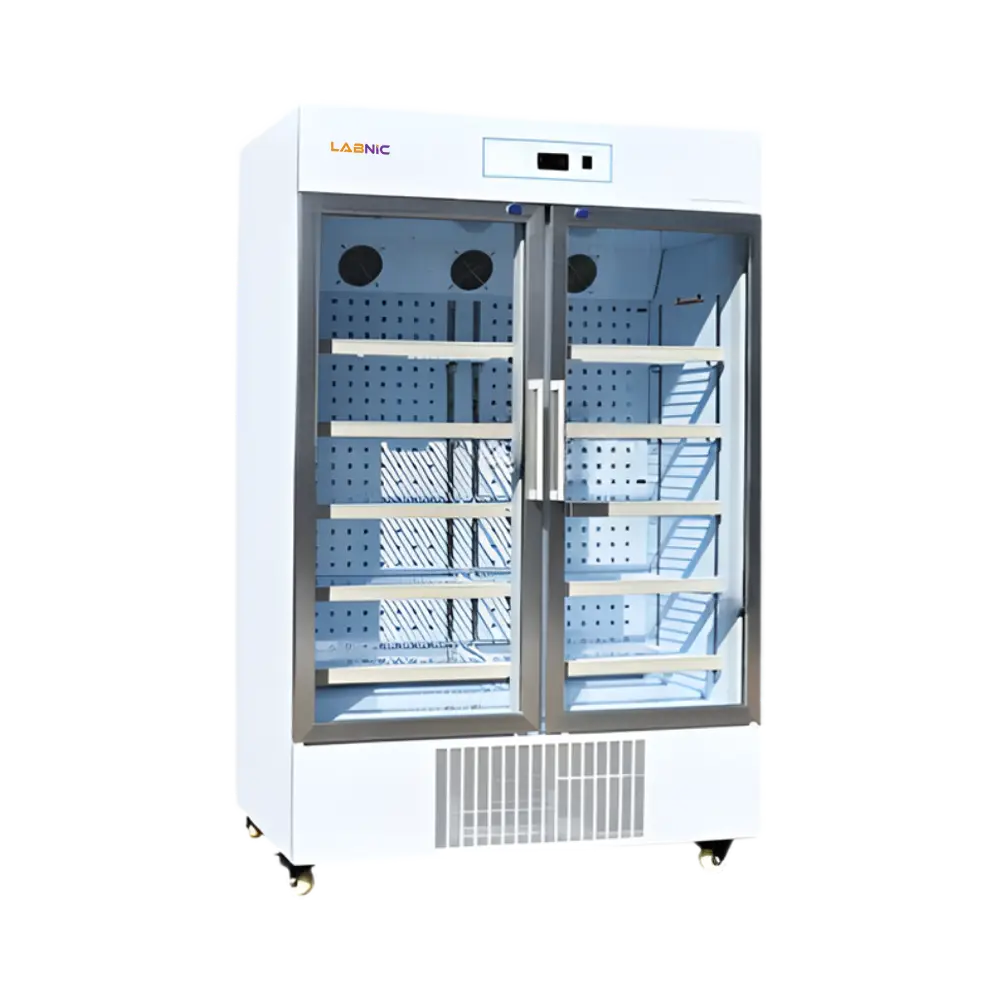
Blood Bank Refrigerator LBN-BR112 provides reliable blood storage with an 800-liter capacity and precise 4°C ±1°C temperature control. It supports high-volume blood bag storage using a forced air-cooling system for uniform temperature distribution. Equipped with a microprocessor-based temperature controller and a 7-inch touchscreen for accurate monitoring. Integrated audio-visual alarms for temperature deviation, power failure, sensor fault, and door ajar conditions to ensure safety. Our Blood Bank Refrigerator is ideal for blood banks, hospitals, transfusion centers, laboratories, and clinical storage applications.
| Gross Volume | 792 L |
|---|---|
| Storage Volume | 645 L |
| Blood Bag Capacity | 450 (450 ml) / 625 (350 ml) |
| Temperature Setpoint | +4°C |
| Temperature Accuracy | ±1°C |
| Temperature Range | 4°C ±1°C |
| Cooling Method | Forced Air Cooling System |
| Defrost System | Automatic |
| Refrigerant | R134a (CFC Free) |
| Chambers | 6 |
| Temperature Controller | Microprocessor-Based |
| Display | 7″ Touchscreen + LED Digital Display |
| Interior Material | Color Sprayed Steel |
| Exterior Material | Color Sprayed Steel |
| Door Type | Double Glass Door |
| Insulation | PURF |
| Alarm Functions | High/Low Temp, Power Failure, Sensor Fault, Door Ajar, System Failure |
| Alarm Type | Audible & Visual |
| Castors | Yes |
| Interior Lighting | LED |
| Noise Level | 42 dB |
| Ambient Temperature | 10°C to 32°C |
| Climate Type | N |
| Electric Shock Protection | Class I Type B |
| Power Consumption | 2.5 kWh / 24 h |
| Power Supply | 220 to 240 V, 50 to 60 Hz |
| Input Power | 350 W |
| External Dimensions (D×W×H) | 1200 × 650 × 1880 mm |
| Package Dimensions (D×W×H) | 1320 × 730 × 2060 mm |
| Net Weight | 100 kg |
| Gross Weight | 120 kg |
Stainless Steel Interior Construction
Double Glass Door Design
Automatic Defrost System
R134a CFC-Free Refrigerant
PURF High-Density Insulation
Lockable Castor Wheels
USB Temperature Data Recording
Blood Bank Refrigerator LBN-BR112 is ideal for blood banks, hospitals, transfusion centers, diagnostic laboratories, research institutions, and clinical facilities requiring safe and compliant blood storage.