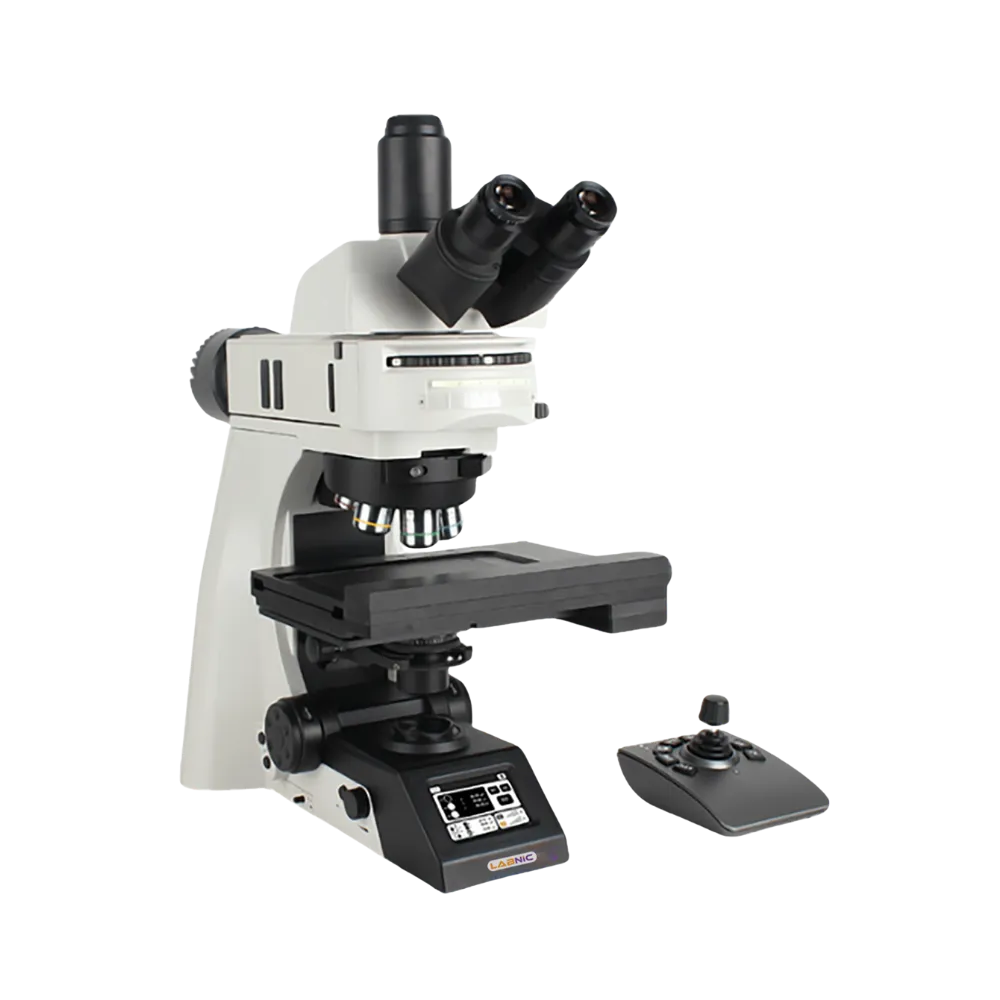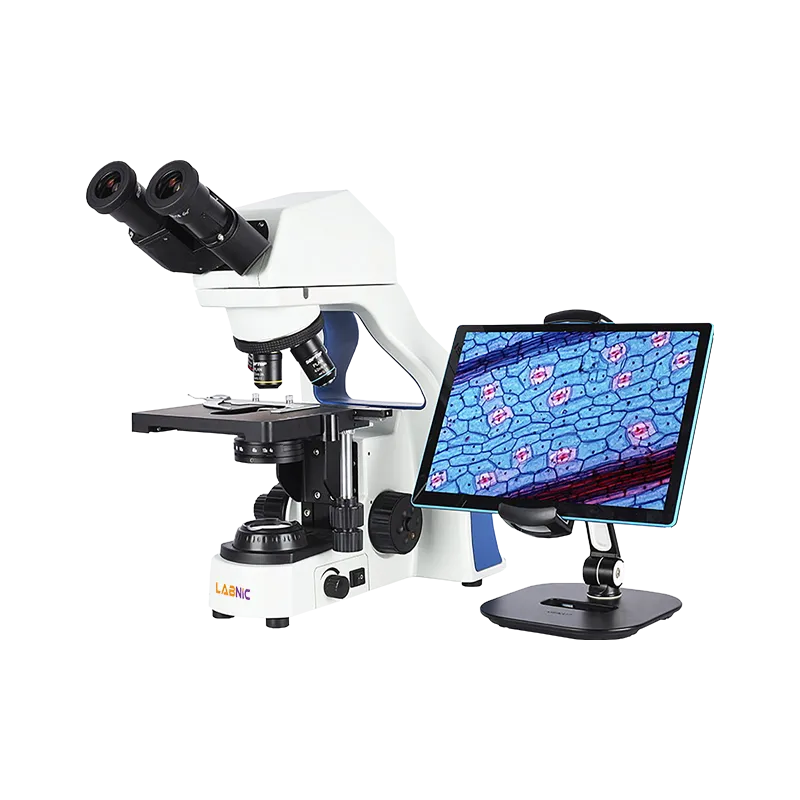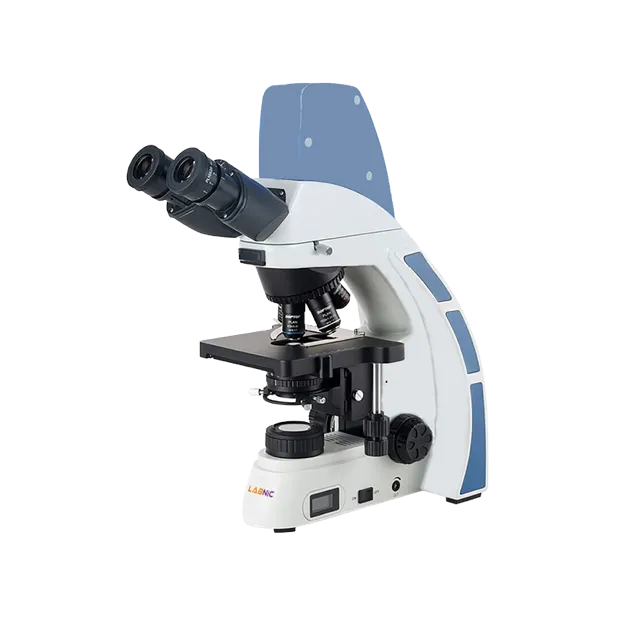
Digital Microscope LBN-DM126 consists of an inward 5-hole nosepiece of the objective-type infinity plan. The head interpupillary distance is 50–75 mm, with a light path of E80:P20. The standard magnification ranges from 40x–1000x, and consists of a double slide holder as a working stage. The Abbe condenser is used with a 1.25 aperture and LED features as the light source.
| Optical System | Infinity Plan |
| Standard Magnification | 40x-1000x |
| Head | Siedentopf Binocular |
| Inclination | 30 degree |
| Rotation | Head Rotate 360 degree |
| Interpupillary | 50-75mm |
| Light Path | E80:P20 |
| Eyepiece Diameter | 30.0mm |
| Nosepiece | Inward 5 holes |
| Objective Type | Infinity Plan |
| Magnification | 4x, 10x, 40x, 100x |
| Stage Dimensions | 150 × 162mm |
| Moving Size | 76 × 50 mm |
| Condenser | Abbe N. A 1.25, Slot for DF Slide, Slot for PH Slide |
| Light Source Type | LED |
| Transmit Light | 3W LED |
| Power Supply Type | AC 110V-240V |
| Camera Output | USB2.0, HDMI, SD Card |
| System Support | Win7, Win10 |
Digital Microscope is used for research analysis of samples, blood, cells, and tissue culture at scientific research institutes, biological and medical institutes, laboratories, health clinics, etc.
Digital Microscope is used for research analysis of samples, blood, cells, and tissue culture at scientific research institutes, biological and medical institutes, laboratories, health clinics, etc.
Most Frequently Asked Questions
1. What are Digital Microscopes used for?
Ans. Digital Microscopes are used for detailed examination and analysis of samples using high-magnification digital imaging.
2. What magnification capabilities are available in Digital Microscopes?
Ans. Digital Microscopes offer a wide magnification range to support detailed observation of various sample types.
3. How do Digital Microscopes support image and video capture?
Ans. Digital Microscopes are equipped with built-in cameras that capture high-quality images and videos.
4. How do Digital Microscopes ensure easy and efficient operation?
Ans. Digital Microscopes feature user-friendly interfaces that allow simple control of settings and functions.
5. How do Digital Microscopes support precise analysis?
Ans. Digital Microscopes combine high-resolution imaging with advanced digital technology for accurate sample analysis.
6. Where are Digital Microscopes commonly used?
Ans. Digital Microscopes are commonly used in research institutes, healthcare clinics, and laboratory environments.
Digital Microscope LBN-DM126 consists of an inward 5-hole nosepiece of the objective-type infinity plan. The head interpupillary distance is 50–75 mm, with a light path of E80:P20. The standard magnification ranges from 40x–1000x, and consists of a double slide holder as a working stage. The Abbe condenser is used with a 1.25 aperture and LED features as the light source.