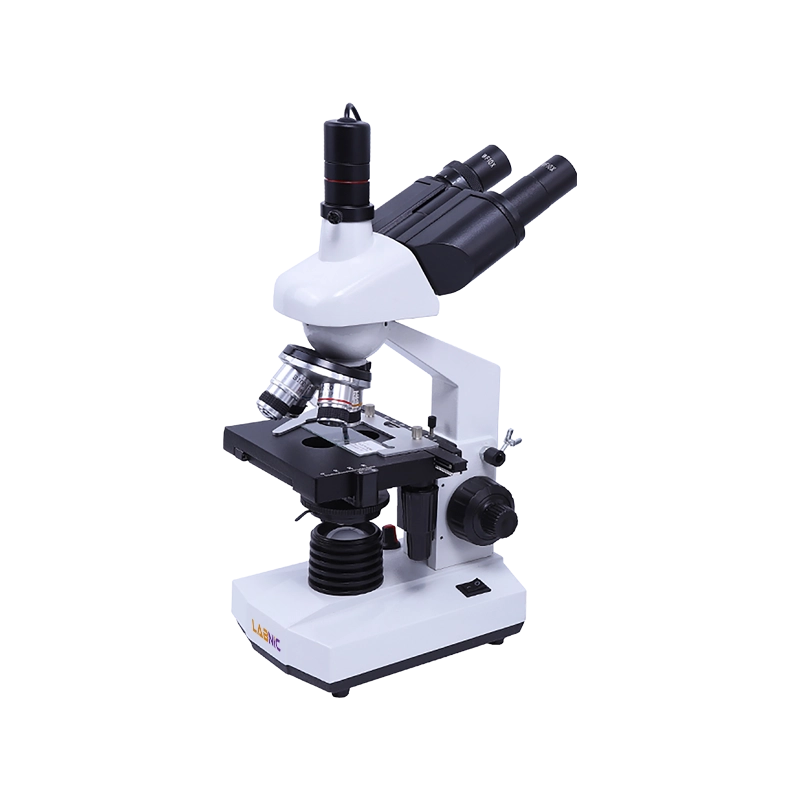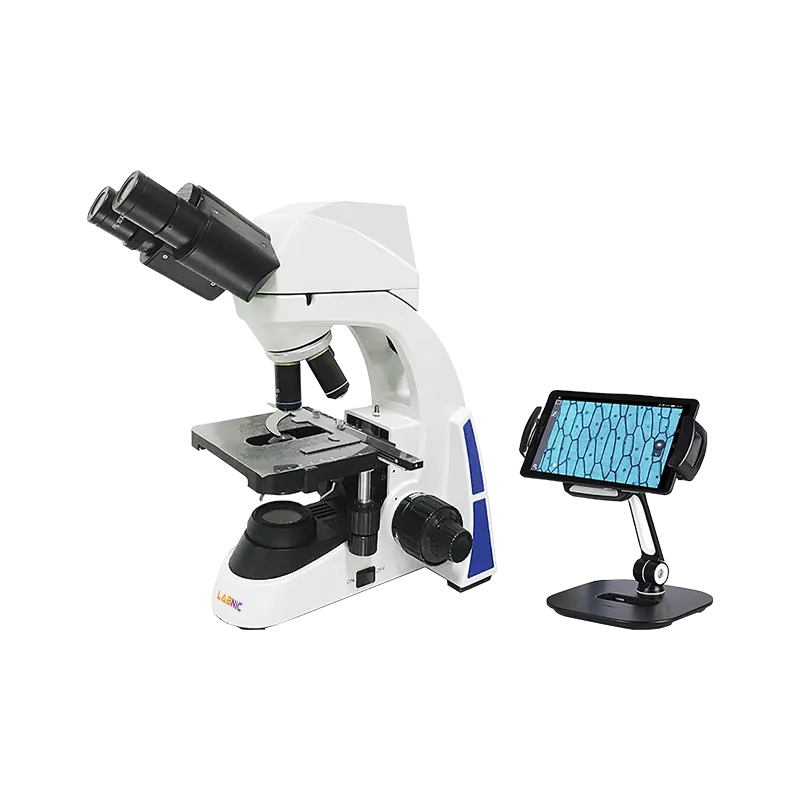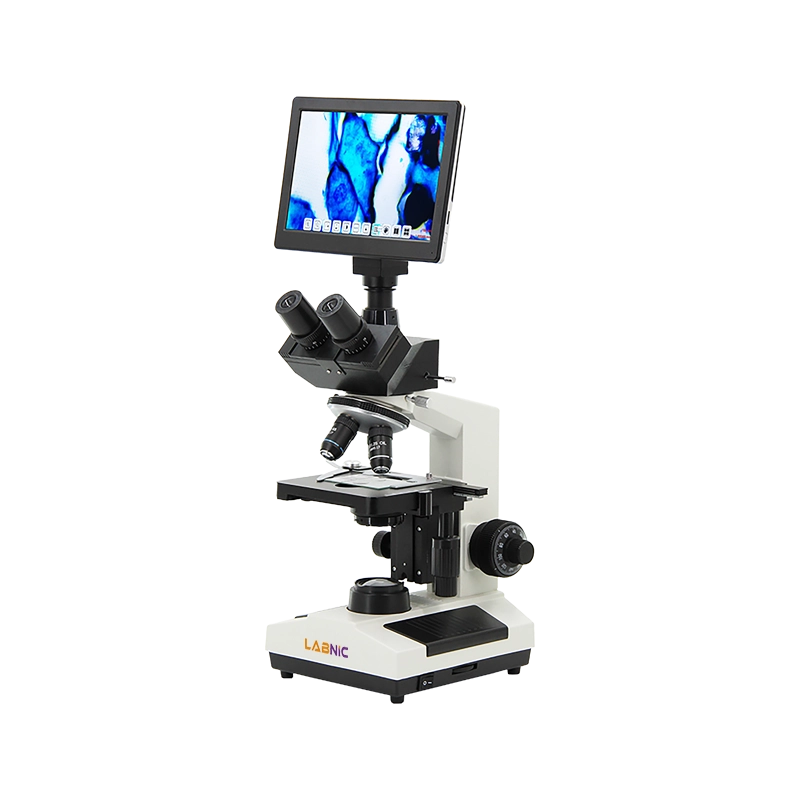
Digital Microscope LBN-DM144 has a sliding trinocular head type with a 55-75mm interpupillary, a 360° head rotation, and a 45° inclination. It has an outward quadruple nosepiece and a 1.25-inch aperture abbe condenser. A 5-megapixel camera with a C-mount and a digital eyepiece with a 23.2-mm diameter are integrated, along with a halogen light source.
| Optical System | Achromatic |
| Standard Magnification | 40x-1600x (optional), 140.68x-3517x (total) |
| Head Type | Siedentopf Trinocular |
| Inclination | 45° |
| Rotation | Head Rotate 360° |
| Interpupillary | 55-75mm |
| Diopter | Both Tube Adjustable |
| Light Path | E100:P0/E0:P100 |
| Eyepiece | WF10x/18mm, 2 pc, WF10x/11mm, 2 pc |
| Diameter | 23.2 mm |
| Nosepiece | Outward 4 holes |
| Objective Type | Achromatic |
| Magnification | 4x, 10x, 40x (s), 100x (o, s) |
| Stage | 2 Layer Mechanical |
| Size | 140 × 140mm |
| Moving Size | 50 × 75mm |
| Focusing Scale | 0.002mm |
| Condenser | Abbe 1.25 N. A |
| Light Source Type | Halogen |
| Transmit Light | 6V20W Halogen |
| Video Adapter | C-Mount 0.1x |
| Pixel | 5.0MP |
| Mounting | C-Mount |
| Output | USB, SD/TF Card, USB Hard Disk |
| Power Supply Type | AC110V-240V |
| Weight | 12Kg |
| Dimensions (L × D × H) | 390 × 350 × 520 mm |
Digital microscope is employed for sample, blood cell, and tissue culture examination, in a variety of settings including medical research facilities, biological research labs, metallurgy, health clinics, etc.
Digital microscope is employed for sample, blood cell, and tissue culture examination, in a variety of settings including medical research facilities, biological research labs, metallurgy, health clinics, etc.
Most Frequently Asked Questions
1. What are Digital Microscopes used for?
Ans. Digital Microscopes are used for detailed examination and analysis of samples using high-magnification digital imaging.
2. What magnification capabilities are available in Digital Microscopes?
Ans. Digital Microscopes offer a wide magnification range to support detailed observation of various sample types.
3. How do Digital Microscopes support image and video capture?
Ans. Digital Microscopes are equipped with built-in cameras that capture high-quality images and videos.
4. How do Digital Microscopes ensure easy and efficient operation?
Ans. Digital Microscopes feature user-friendly interfaces that allow simple control of settings and functions.
5. How do Digital Microscopes support precise analysis?
Ans. Digital Microscopes combine high-resolution imaging with advanced digital technology for accurate sample analysis.
6. Where are Digital Microscopes commonly used?
Ans. Digital Microscopes are commonly used in research institutes, healthcare clinics, and laboratory environments.
Digital Microscope LBN-DM144 has a sliding trinocular head type with a 55-75mm interpupillary, a 360° head rotation, and a 45° inclination. It has an outward quadruple nosepiece and a 1.25-inch aperture abbe condenser. A 5-megapixel camera with a C-mount and a digital eyepiece with a 23.2-mm diameter are integrated, along with a halogen light source.